Spatial Vector Algebra Basics
Rigid-body motion is most naturally described using the Lie group \(SE(3)\) and its Lie algebra \(\mathfrak{se}(3)\). Spatial Vector Algebra (SVA) is a coordinate realization of these objects, producing a unified framework for rigid-body kinematics and dynamics. The algebra respects the adjoint and co-adjoint structures of the group and produces numerically stable equations of motion with minimal overhead.
Spatial Motion Vectors (Twists)
A spatial motion vector (or twist) is an element of \(\mathfrak{se}(3)\) represented in coordinates as
where \(\boldsymbol{\omega}\) is the angular velocity and \(\mathbf{v}\) is the linear velocity of a point fixed in the body.
The corresponding matrix in \(\mathfrak{se}(3)\) is
A rigid body’s configuration \(X \in SE(3)\) obeys
Spatial Force Vectors (Wrenches)
A spatial force vector (or wrench) is an element of the dual space \(\mathfrak{se}(3)^* \cong \mathbb{R}^{6*}\). In coordinates,
where \(\mathbf{n}\) is the moment and \(\mathbf{f}\) is the linear force. The natural duality pairing giving instantaneous power is
Spatial Cross Product for Motion Vectors
The Lie bracket on \(\mathfrak{se}(3)\) induces the spatial cross product
Spatial Cross Product for Forces
The co-adjoint action yields
Spatial Transforms
A transform \({}_A X_B \in SE(3)\) maps vectors from frame \(B\) to frame \(A\). Let \({}_A X_B = (R, p)\) with \(R \in SO(3)\), \(p \in \mathbb{R}^3\).
Action on Motion Vectors (Adjoint Map)
and motion vectors transform as
Action on Forces (Co-Adjoint Map)
which preserves duality:
Spatial Inertia
For mass \(m\), center of mass \(c_F\) (expressed in frame \(F\)), and rotational inertia \(IC_F\) at the COM:
Spatial inertias transform by the co-adjoint sandwich
Newton Euler Equations in Spatial Form
The rigid-body equations of motion are
and are covariant under all frame changes in \(SE(3)\).
Benefits of SVA for GNC and EKF Design
SVA replaces separate translational and rotational equations with a single 6-D rigid-body equation
where \(\mathbf{v}, \mathbf{a} \in \mathbb{R}^6\) are spatial velocity and acceleration, \(\mathbf{I} \in \mathbb{R}^{6\times 6}\) is the spatial inertia, and \(\mathbf{f} \in \mathbb{R}^6\) is the net spatial wrench.
This unification is especially helpful for:
GNC design,
Extended Kalman Filters (EKF),
algorithmic differentiation and code generation.
EKF-Friendly Dynamics and Jacobians
In an inertial frame formulation, all pseudo-forces are eliminated and Earth’s rotation enters only through the atmospheric velocity model.
The dynamics are
and the EKF requires the state-transition Jacobian
and measurement Jacobian
where \(h(x)\) encodes sensor models (IMU, GPS, star tracker, etc.).
Building blocks of \(f(x,u)\) in SVA:
fixed-size matrices (\(6\times 6\) spatial inertia, adjoints, cross operators),
bilinear cross operators \(\mathbf{v} \times\), \(\mathbf{v} \times^*\),
smooth frame transforms between body, inertial, and sensor frames.
These are smooth and branch-free, making them ideal for algorithmic differentiation (e.g. CppAD) to generate \(\mathbf{F}\) and \(\mathbf{H}\) automatically.
Consistent Sensor Models in Body Frame
IMU sensors are naturally expressed in the body frame. Using SVA, the same spatial quantities used in the dynamics appear in the measurement models. Accelerometer and gyroscope measurements become smooth functions of \((\mathbf{v}_B, \mathbf{a}_B, R_{WB})\), without ad-hoc mixing of coordinates.
Numerical Robustness and Real-Time Implementation
Because SVA is conceptually coordinate-free and implemented via fixed-size linear algebra, it is well suited to
high-order ODE solvers in flight simulation,
embedded real-time targets with limited resources,
code generation pipelines where both dynamics and Jacobians are needed.
The absence of pseudo-forces and singular parameterizations improves numerical stability and reduces the risk of EKF divergence.
GNC and EKF Pipeline Diagram
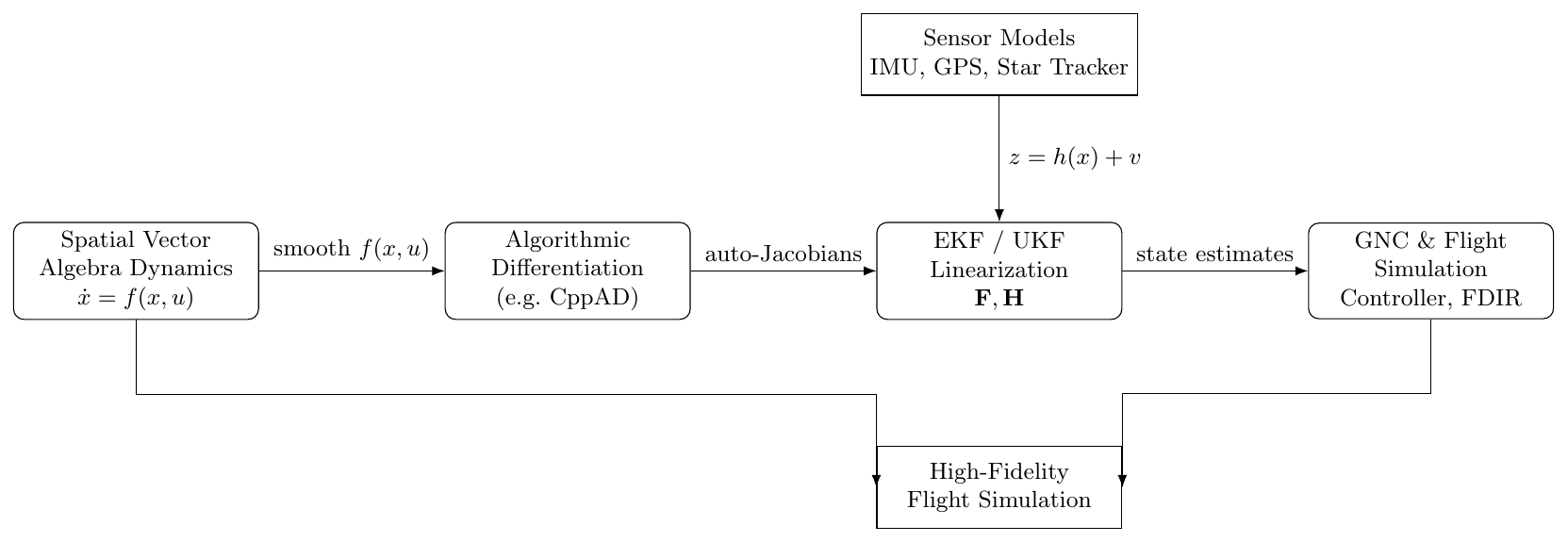
Role of Spatial Vector Algebra in the GNC and EKF pipeline. SVA provides a smooth, unified 6-D dynamics model compatible with algorithmic differentiation and real-time GNC implementation.